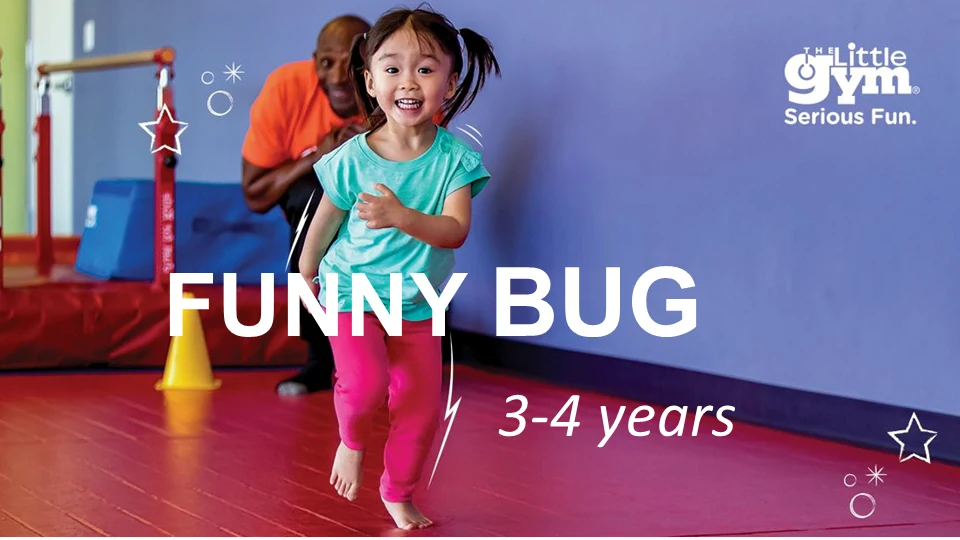
Funny Bugs welcomes children into their first independent class. Imaginative themes, clear routines and approachable gymnastics challenges help them practise separation, listening, friendship and the pride of doing something for themselves.
How the class worksChildren participate independently while parents watch nearby.
FB
Why this age matters
Learning through independent action
At three, children are ready to test “me do it” inside a safe structure. Balance, coordination and power grow alongside classroom readiness: joining a group, listening to a teacher, moving between activities and recovering after a challenge.
Body + brain together
The developmental focus for this age
The original program framework connects sensory processing, reflexes, language and motor development. The emphasis changes as children grow.
↔Body & Brain · Relationship Development3–4 years
SensoryReflexesFine & Gross Motor
The senses
Sight
Hearing
Touch
Focus for this ageSupporting
Balance · Vestibular
Posture
Balance
Alertness
Concentration
Stillness
Focus for this ageEmerging focus
Body intuition · Proprioception
Body awareness
Spatial awareness
Sub-conscious movement
Strength management
Focus for this ageActive focus
Language
Verbal
Physical
Musical
Symbolic
Focus for this ageActive focus
Coordination
Midlines
Dominance
Body rhythm
Timing
Focus for this ageStrong focus
Power
Strength
Stamina
Flexibility
Agility
Focus for this ageEmerging focus
Control
Positioning
Pacing
Pressure & force
Eye–body coordination
Focus for this ageSupporting
Four connected outcomes
Gymnastics is only the beginning
Every activity has a physical purpose and a wider developmental purpose. The goal is confident progress that children can carry into everyday life.
01
Independent confidence
Children make choices, accept help and complete small tasks without a caregiver in the room.
02
Balance, coordination & power
Foundational gymnastics creates a broad, useful movement vocabulary.
03
Classroom readiness
Short directions and activity transitions practise listening and flexible attention.
04
Friendship skills
Turn-taking, waiting and sharing equipment make social rules concrete.
A purposeful rhythm
A normal class, step by step
Familiar structure helps children feel secure, while new weekly themes and skill progressions keep curiosity alive.
✦
Weekly class approach
A 60-minute independent class that combines group play with three gymnastics stations
Hello Song — a calm, familiar rhythm that helps children settle into class
Name Song — every child is welcomed by name and introduced to the group
✓What it develops
Helps children settle and recognise the class rhythm
Creates a welcoming social experience without a parent in the gym
02
Warm-Up
5 minutes
+Open details
→What children do
Yoga poses
Flexing and stretching
Creative movement
Running, jumping and locomotor patterns
Forward rolls, cartwheels and age-right tumbling preparation
✓What it develops
Fun exercise linked to music, rhythm and listening
Uses imagination to make movement meaningful
Develops spatial awareness
Supports muscle and tendon flexibility and healthy circulation
03
Group Activity
8 minutes
+Open details
→What children do
Parachute
Rhythm sticks
Stretch rope
Scarves
Air mat
Hoops
Bean bags
Jump rope
✓What it develops
Cooperation and social skills in a group
New movement ideas using equipment and music
Listening and responding to rhythm
04
Gymnastics — 3 Stations
30 minutes
+Open details
→What children do
Bars — Pull Over, Back Hip Circle and progressive hanging skills
Beam and floor — Cartwheel, Forward Roll and balance progressions
Rings — L-shape, Straddle and strength positions
Vault — Direct Vault, Handspring preparation and safe landings
✓What it develops
Builds a broad foundation of gymnastics skills
Develops courage and confidence through achievable challenges
Encourages children to think, solve problems and say, “I can do it myself”
Strengthens the whole body with careful progressions
05
Game
8 minutes
+Open details
→What children do
Ball skills — throw, catch and pass with hands or feet
Hide & Seek
Duck, Duck, Goose
Soccer and basketball
Back-to-back partner games
✓What it develops
Hand, foot and eye coordination
Listening and concentration
Cooperation and cognitive sequencing
Rules, sportsmanship and etiquette
06
Closing
2 minutes
+Open details
→What children do
Celebrate effort and reconnect with the group
✓What it develops
Ends independent participation with confidence
The original Bangkok program deck
See the complete class presentation
Move through the original slides to understand the developmental focus, weekly structure and activities parents and children experience during a normal class.
Use the arrows, thumbnails, or your keyboard to move through the deck.
FBFunny Bugs · 3–4 years
Slide 1 of 8
iThe slides are presented in their original form. Use the page language switch for the bilingual guide around them.
Age-right development
Milestones we support
Development is individual and rarely linear. These are common signs of growing confidence, not a checklist or promise.
◎
Milestones we support
✓Joining a class without a caregiver
✓Following one- and two-step directions
✓Jumping and landing on two feet
✓Walking along a low beam
✓Taking a short turn and rejoining the group
↗
Skills children explore
✓Forward-roll foundations
✓Beam walks and balances
✓Two-foot jumps and safe landings
✓Bar hangs and swings
✓Obstacle courses with direction changes
✦
What parents may notice
✓More comfortable saying goodbye at the class door
✓Greater willingness to listen to another trusted adult
✓Pride in saying, “I did it myself”
✓Better turn-taking and recovery after frustration
See Serious Fun
See imaginative play inside a Funny Bugs class
A real Bangkok class clip gives you a feel for the pace, coaching and joyful atmosphere.
 Bangkok