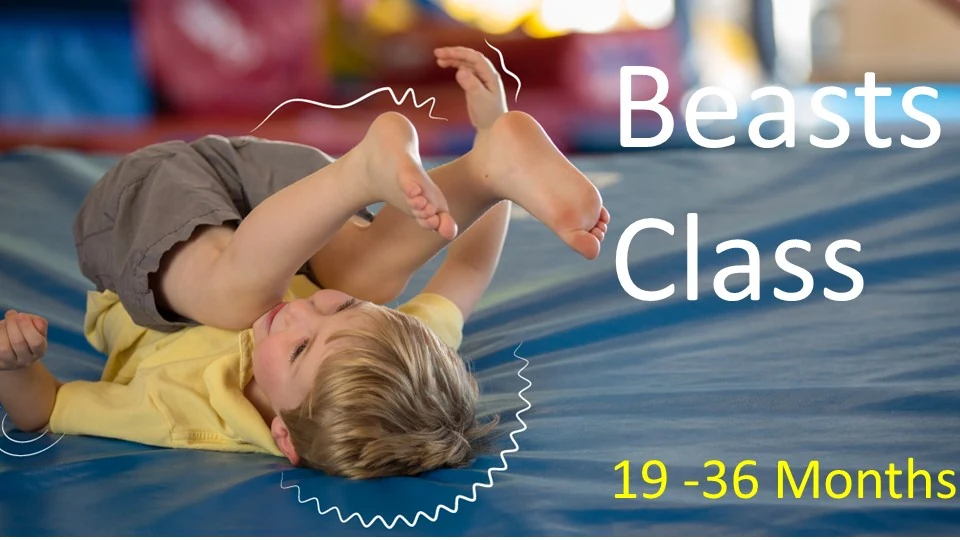
Beasts gives active toddlers room to run, jump, climb, hang and roll while learning how to participate in a group. Caregivers guide without taking over, helping children turn growing independence into confident, coordinated action.
How the class worksA parent or caregiver joins, then gradually gives the child more room to lead.
BS
Why this age matters
Consolidating skills for learning
Toddlers are combining movements that once happened separately. Running into a jump, climbing and turning, or moving to a rhythm all require two sides of the body, attention and planning to work together.
Body + brain together
The developmental focus for this age
The original program framework connects sensory processing, reflexes, language and motor development. The emphasis changes as children grow.
↔Body & Brain · Relationship Development19 months–3 years
SensoryReflexesFine & Gross Motor
The senses
Sight
Hearing
Touch
Focus for this ageEmerging focus
Balance · Vestibular
Posture
Balance
Alertness
Concentration
Stillness
Focus for this ageActive focus
Body intuition · Proprioception
Body awareness
Spatial awareness
Sub-conscious movement
Strength management
Focus for this ageStrong focus
Language
Verbal
Physical
Musical
Symbolic
Focus for this ageActive focus
Coordination
Midlines
Dominance
Body rhythm
Timing
Focus for this ageActive focus
Power
Strength
Stamina
Flexibility
Agility
Focus for this ageEmerging focus
Control
Positioning
Pacing
Pressure & force
Eye–body coordination
Focus for this ageSupporting
Four connected outcomes
Gymnastics is only the beginning
Every activity has a physical purpose and a wider developmental purpose. The goal is confident progress that children can carry into everyday life.
01
Powerful gross motor skills
Running, jumping, climbing and hanging develop strength, endurance and control.
02
Two-sided coordination
Combined actions teach both sides of the body to work together.
03
Social beginnings
Waiting, sharing and taking turns begin inside short, supported routines.
04
Positive independence
Choices and achievable challenges let toddlers practise saying, “I can try.”
A purposeful rhythm
A normal class, step by step
Familiar structure helps children feel secure, while new weekly themes and skill progressions keep curiosity alive.
✦
Weekly class approach
A 45-minute parent-and-toddler class with a fresh movement theme each week
Hello Song — a calm, familiar rhythm that helps children settle into class
Name Song — every child is welcomed by name and introduced to the group
Perceptual Motor Song — moving body parts to music, such as Twinkle or Put Your Finger on Your Nose
✓What it develops
Language and early number concepts
Listening, anticipation and musical rhythm
Body awareness and a positive first social experience
02
Warm-Up
5 minutes
+Open details
→What children do
Sit Ups
Upside Down
Helicopter
Wheel Barrow
Fireman Carry
Forward Rolls
Sack of Potatoes
Donkey Kicks
Log Rolls
Backward Rolls
Flagpole
Finger Hang
Baby Trade
Rocking Chair
Back Whoop-Dee-Doo
✓What it develops
Fun whole-body exercise shared with a trusted caregiver
Strengthens the parent–child exercise relationship
Provides rich vestibular sensory input
Practises directions such as walk, stop, run, left, right and wait
Develops locomotor, spatial-awareness, tumbling and yoga skills
03
Group Activity
10 minutes
+Open details
→What children do
Parachute
Rhythm sticks
Stretch rope
Scarves
Air mat
Hoops
Bean bags
✓What it develops
Listening, rhythm and movement with music
Exercise, strength and coordinated movement
Parallel play begins to grow into associative play
Position words such as under/over, right/left and through
04
Exploration
15 minutes
+Open details
→What children do
Walking and running pathways
Low balance beam
Bar activities — hanging and turning
Climbing
Rolling Hot Dog
Sitting in the donut
Balance Beam
Land Surfing
Donut Rides and Donut Walk
Hoop Walk
Hot Dog Walk
✓What it develops
Safe challenges make children more comfortable trying new things
Strengthens body and mind through discovery
Makes running and jumping more complete and stable
Introduces a wide base of early gymnastics skills
05
Ball Time
2 minutes
+Open details
→What children do
Throw, catch and pass balls using hands and feet
Follow simple directions and move to the musical rhythm
✓What it develops
Hand–foot and foot–eye coordination
Listening to and acting on directions
Balance and body awareness while moving around the ball
06
Bubbles
2 minutes
+Open details
→What children do
Track floating bubbles with the eyes
Walk or crawl to reach, touch and catch them
✓What it develops
Visual tracking
Foot, hand and eye coordination
Body awareness
Motor perception
07
Closing
1 minutes
+Open details
→What children do
A short group goodbye and celebration of effort
✓What it develops
Creates a predictable, positive transition
The original Bangkok program deck
See the complete class presentation
Move through the original slides to understand the developmental focus, weekly structure and activities parents and children experience during a normal class.
Use the arrows, thumbnails, or your keyboard to move through the deck.
BSBeasts · 19 months–3 years
Slide 1 of 9
iThe slides are presented in their original form. Use the page language switch for the bilingual guide around them.
Age-right development
Milestones we support
Development is individual and rarely linear. These are common signs of growing confidence, not a checklist or promise.
◎
Milestones we support
✓Running with growing control
✓Two-foot take-off or early jumping
✓Climbing and descending
✓Beginning to follow a two-part routine
✓Parallel play and early turn-taking
↗
Skills children explore
✓Running and stop-start games
✓Two-foot jumping
✓Forward-roll preparation
✓Low beam and obstacle paths
✓Supported bars and hanging
✦
What parents may notice
✓Smoother running, climbing and landing
✓Longer attention within a simple routine
✓More words or gestures to express needs
✓Early patience around turns and shared equipment
See Serious Fun
See a Beasts class in action
A real Bangkok class clip gives you a feel for the pace, coaching and joyful atmosphere.
 Bangkok