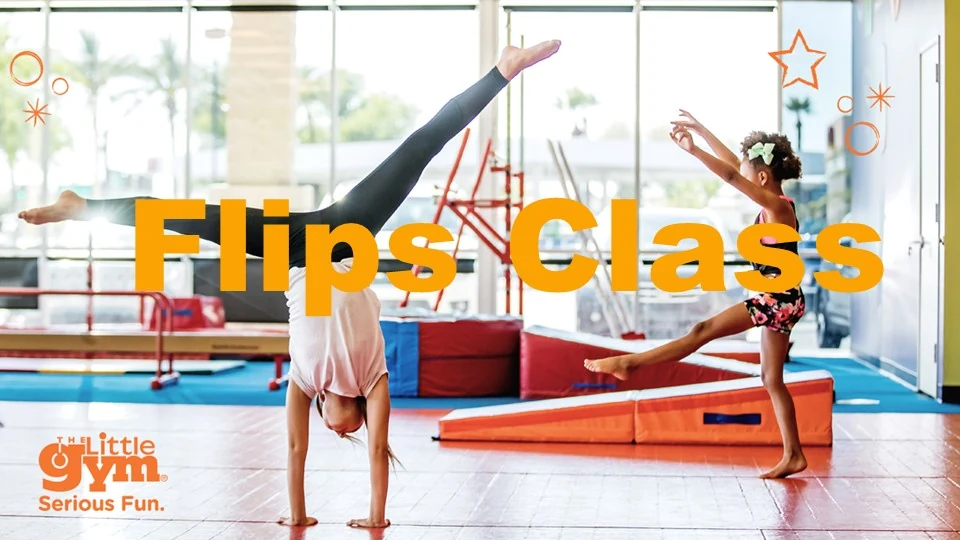
Flips gives grade-school gymnasts a clear path from foundations toward more advanced floor, beam, bars and vault skills. Coaching is individualised, non-competitive and centred on safe technique, persistence and earned pride.
How the class worksChildren train independently with skill progressions matched to their level.
FL
Why this age matters
Progressing from foundations to mastery
Older children are ready to understand why technique matters, set longer-term goals and work through plateaus. Progress may be a new skill, cleaner form, greater strength or the courage to try again—all are meaningful.
Body + brain together
The developmental focus for this age
The original program framework connects sensory processing, reflexes, language and motor development. The emphasis changes as children grow.
↔Body & Brain · Relationship Development7–12 years
SensoryReflexesFine & Gross Motor
The senses
Sight
Hearing
Touch
Focus for this ageSupporting
Balance · Vestibular
Posture
Balance
Alertness
Concentration
Stillness
Focus for this ageEmerging focus
Body intuition · Proprioception
Body awareness
Spatial awareness
Sub-conscious movement
Strength management
Focus for this ageActive focus
Language
Verbal
Physical
Musical
Symbolic
Focus for this ageActive focus
Coordination
Midlines
Dominance
Body rhythm
Timing
Focus for this ageActive focus
Power
Strength
Stamina
Flexibility
Agility
Focus for this ageStrong focus
Control
Positioning
Pacing
Pressure & force
Eye–body coordination
Focus for this ageStrong focus
Four connected outcomes
Gymnastics is only the beginning
Every activity has a physical purpose and a wider developmental purpose. The goal is confident progress that children can carry into everyday life.
01
Progressive technique
Skills are broken into safe drills that build strength, form and understanding.
02
Personal goal-setting
Each gymnast can identify a next step and take ownership of practice.
03
Persistence
Repeated attempts teach patience, adjustment and calm recovery after mistakes.
04
Strength with safe sense
Body awareness, control and spotting help children assess challenge more wisely.
A purposeful rhythm
A normal class, step by step
Familiar structure helps children feel secure, while new weekly themes and skill progressions keep curiosity alive.
✦
Weekly class approach
A 75-minute gymnastics class with deeper tumbling practice and three apparatus stations
Develops locomotor, gymnastics and motor-coordination skills
Improves flexibility and circulation while helping reduce injury risk
Practises listening, cooperation and positive social participation
03
Group Tumbling
15 minutes
+Open details
→What children do
Handstand
Forward Roll
Backward Roll
Cartwheel
Front Walkover
Back Walkover
Front Tuck
Back Tuck
Straddle Roll
Aerial Cartwheel
Straddle Forward Roll
✓What it develops
Builds bone and muscle strength
Improves balance and whole-body flexibility
Develops precise body control
Builds patience, discipline and confidence
Creates a strong foundation for other sports and dance
04
Gymnastics — 3 Stations
30 minutes
+Open details
→What children do
Bars — Pull Over, Back Hip Circle and progressive hanging skills
Beam and floor — Cartwheel, Forward Roll and balance progressions
Rings — L-shape, Straddle and strength positions
Vault — Direct Vault, Handspring preparation and safe landings
✓What it develops
Builds a broad foundation of gymnastics skills
Develops courage and confidence through achievable challenges
Encourages children to think, solve problems and say, “I can do it myself”
Strengthens the whole body with careful progressions
05
Game
13 minutes
+Open details
→What children do
Revisit learned gymnastics skills in fast-moving, cooperative games
✓What it develops
Makes practice fun and gives children a positive way to relax
Teaches rules, turn-taking, sportsmanship and etiquette
Practises winning, losing, forgiving and playing socially
Develops judgement, quick reactions, problem solving and sequencing
06
Closing
2 minutes
+Open details
→What children do
Review the focus skill and recognise individual effort
✓What it develops
Turns practice into a visible sense of personal progress
Designed for lasting participation
Why this format works so well
The older-child decks explain why gymnastics at The Little Gym is an unusually versatile foundation for an active childhood.
01
Easy to join — children only need comfortable clothing, not special equipment
02
A comfortable indoor, air-conditioned environment away from heat and PM2.5
03
A non-contact activity with carefully managed progressions
04
Non-competitive — progress is measured against each child’s own starting point
05
Never repetitive — more than 30 gymnastics skills, 20+ pieces of equipment and a new weekly focus
06
Exercise and games combine to make movement joyful and relieve stress
07
Challenges develop confidence, patience, discipline and the satisfaction of success
08
Gymnastics creates a transferable foundation for sports, dance and ballet
The original Bangkok program deck
See the complete class presentation
Move through the original slides to understand the developmental focus, weekly structure and activities parents and children experience during a normal class.
Use the arrows, thumbnails, or your keyboard to move through the deck.
FLFlips · 7–12 years
Slide 1 of 9
iThe slides are presented in their original form. Use the page language switch for the bilingual guide around them.
Age-right development
Milestones we support
Development is individual and rarely linear. These are common signs of growing confidence, not a checklist or promise.
◎
Milestones we support
✓Holding technically stronger handstand shapes
✓Connecting skills into a sequence
✓Adjusting technique after feedback
✓Setting and tracking a personal goal
✓Supporting teammates without comparison
↗
Skills children explore
✓Handstands, cartwheels and round-offs
✓Forward and backward tumbling progressions
✓Beam turns, leaps and combinations
✓Bar swings, supports and strength shapes
✓Vault progressions and controlled landings
✦
What parents may notice
✓Better body control and posture
✓More ownership of practice and preparation
✓Greater tolerance for skills that take time
✓Confidence grounded in real, earned progress
See Serious Fun
See the Flips class environment
A real Bangkok class clip gives you a feel for the pace, coaching and joyful atmosphere.
 Bangkok